
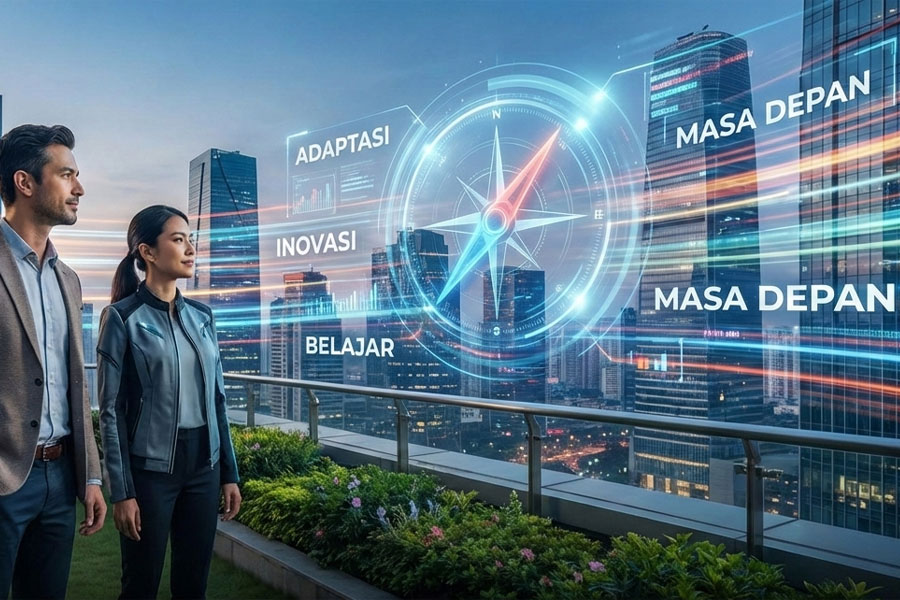
Change is no longer something that occurs occasionally. Instead, it has become a continuous condition—driven by digital transformation, market dynamics, and shifts in customer behavior. In such a situation, the role of leaders is no longer merely to maintain stability, but to help organizations adapt and move forward with clear direction.
Various leadership studies show that the ability to lead through change is becoming increasingly important. Global leadership research highlighted by Harvard Business indicates that more organizations are placing the ability to lead change as a core leadership competency, as change today is continuous rather than temporary.
Harvard Business Review also emphasizes that change now happens on an ongoing basis, and leaders need to help teams maintain agility while addressing fatigue caused by constant change.
Meanwhile, studies by McKinsey suggest that a central task of leadership today is managing change by recognizing new realities and encouraging organizational adaptation. Many organizations even need to go beyond traditional change approaches and learn to renew themselves more fundamentally in order to remain relevant.
This explains why today’s leaders need to develop an adaptive mindset, remain open to learning, and be capable of mobilizing teams to stay focused and productive amid uncertainty.
Learning to Lead in an Era of Uncertainty
The ability to lead change is not formed instantly. It develops through learning, reflection, and discussion of real experiences.
Therefore, learning spaces that allow leaders to exchange experiences, study cases, and connect insights with real organizational challenges have become increasingly important.
Through the LeaderSHIFT Coffee Talk, Qando Qoaching provides a learning space designed to help leaders strengthen adaptive leadership capabilities that are relevant to today’s workplace challenges. The program is delivered through a series of interactive, reflective, and practical sessions, ensuring that learning does not stop at insight but continues into real workplace application.
This learning process is also reinforced through flexible digital learning, including the module Leading Change in an Uncertain World. Through continuous learning, leaders can deepen their understanding, experiment with new approaches, and gradually build more adaptive leadership habits.
Becoming Leaders Ready for the Future
Ultimately, organizations that survive and grow are not those that are the biggest or the strongest, but those that learn and adapt the fastest.
In the midst of increasingly rapid change, leadership is no longer about controlling everything, but about helping teams understand direction, sustain motivation, and move forward together toward a better future.

