
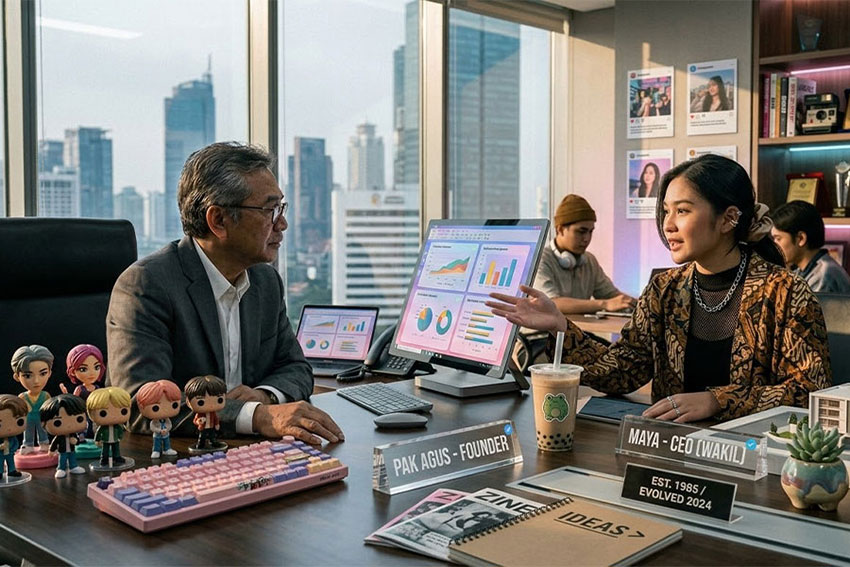
Understanding the Mindset Shift of the Next Generation in Modern Family Businesses
In many family businesses, certain phrases are often heard — sometimes spoken with exhaustion, sometimes with quiet disappointment.
“Kids these days lack resilience.”
“They don’t work as hard as we used to.”
“They want too much without putting in enough effort.”
These narratives are not new. Nearly every generational transition carries similar sentiments. Yet if we look deeper, perhaps the issue is not about laziness at all. Perhaps what we are witnessing is something far more complex: a fundamental shift in how work, leadership, and success are defined.
Family businesses have always existed between two worlds — tradition and change. Founders often built their enterprises through years of sacrifice, uncertainty, and relentless perseverance. Their understanding of commitment was shaped by long hours, physical presence, and unwavering dedication. For them, hard work meant showing up consistently and doing whatever it took to ensure survival and growth.
The next generation, however, has grown up in an entirely different environment. They live in a digital era defined by rapid technological change, limitless access to information, and evolving expectations around work and life. Success is no longer measured solely by financial stability or organizational longevity. Meaning, purpose, flexibility, and personal fulfillment have become equally important markers of achievement.
This difference in context often creates misunderstanding.
What founders may interpret as a lack of dedication could actually be an attempt by the next generation to work in ways that are more relevant to today’s realities. They are not rejecting hard work; they are questioning whether hard work must always look the same as it did in the past.
For many founders, commitment is visible through time and presence — arriving early, leaving late, and remaining constantly available. This has been the language of responsibility they know. The next generation, on the other hand, tends to prioritize efficiency, system thinking, automation, and technological leverage. To them, working smarter does not mean avoiding effort; it means maximizing impact while preserving sustainability.
This shift in definition creates a subtle yet powerful gap. Founders may feel that younger leaders are moving too fast, challenging too much, or lacking patience. Meanwhile, the next generation may feel unheard, constrained, or underestimated. Beneath these tensions lies a shared intention: both generations ultimately want the business to survive and thrive.
One of the most significant changes brought by the next generation is not merely technological adoption but a deeper questioning of meaning. Many successors no longer view the family business solely as an obligation or inherited duty. They seek alignment between personal identity and professional role. They ask whether they have the freedom to shape the business according to their own vision, and whether their leadership can reflect who they truly are.
Such questions are sometimes misinterpreted as disloyalty. In reality, they often signal a desire for authentic engagement. Without emotional connection and personal purpose, it becomes difficult for the next generation to invest the level of energy required to lead in an increasingly complex world.
At the same time, founders carry fears that are rarely articulated. There may be anxiety about losing control, about seeing years of hard-earned legacy transformed too quickly, or about losing relevance as leadership evolves. Resistance to change is often less about stubbornness and more about protecting something deeply meaningful.
When these fears remain unspoken, conflict tends to emerge indirectly — decisions stall, communication becomes defensive, and innovation slows down due to a lack of trust. The next generation, in turn, may experience frustration when their ideas are met with hesitation or skepticism.
The digital era amplifies these dynamics. Younger leaders see opportunities in data-driven decision-making, digital branding, artificial intelligence, and new business models. They are not necessarily seeking to discard tradition, but rather to translate it into a language that resonates with contemporary markets and future challenges. The real question is not whether change should happen, but how change can occur without threatening the core identity of the business.
Another rarely discussed reality is the identity struggle faced by many successors. Being the child of a founder is not a simple position. They often wonder whether respect is earned through competence or inherited through family name. They must learn to lead while standing in the shadow of someone who has already built a strong legacy. This pressure can make them appear uncertain or hesitant, even when they possess strong capabilities.
Because of this, focusing solely on succession planning is often insufficient. The deeper question is not just who will take over, but how leadership itself will evolve. Generational transition should be viewed as a leadership shift — an opportunity to combine the wisdom of experience with the agility of new perspectives.
Family businesses that succeed across generations are rarely those that rigidly preserve every old practice. Instead, they maintain their core values while allowing their methods to evolve. They recognize that generational tension is not necessarily a sign of failure but a natural part of growth.
When honest dialogue takes place, founders may begin to see that the next generation is not trying to dismantle what has been built. Rather, they are striving to ensure that the legacy remains relevant in a rapidly changing world. And when successors learn to appreciate the depth of sacrifice and resilience behind the business’s history, they gain a stronger foundation upon which to innovate.
Ultimately, the question of whether the next generation is lazy becomes irrelevant. The more important question is whether we are willing to accept that definitions of hard work, leadership, and success have evolved.
Perhaps the next generation refuses to repeat old ways not because they reject tradition, but because they want to preserve its essence in a future that looks very different from the past. They are not fighting against legacy; they are translating it.
Family businesses are more than economic entities. They are spaces where relationships, identity, and shared vision intersect. When each generation begins to see the other not as an obstacle but as a partner, change becomes less threatening and more transformative — opening the possibility for a stronger and more meaningful future.
Through training and coaching programs with the expert team at Qando Qoaching, organizations and family businesses can strengthen intergenerational communication, develop adaptive leadership, and create reflective spaces that support sustainable transformation. Because true continuity in family business is not only about preserving the company, but about enabling every generation to grow together.
Mari melangkah bersama menuju Indonesia hebat.
Visit: linktr.ee/qando.community and follow Qando Qoaching on social media for more insights and learning opportunities!

